What is a reinforced (yarn-reinforced) hose, and how do you choose one?
Reinforced hoses are primarily used in agricultural irrigation. Thanks to their high flexibility and lightweight nature, they are suitable for use on various types of terrain and are employed to convey water across diverse irrigation systems.
The reinforced hose—often referred to simply as a “yarn hose”—is a widely used type of flexible irrigation equipment. Valued for its durability and longevity, it is utilized in various drip and sprinkler irrigation systems.
Known for being lightweight and easy to handle, these agricultural hoses are designed to be easily rolled up and stored when not in use. This article examines the features, applications, benefits, and maintenance tips for maximizing the lifespan of this type of hose.
Features of Collapsible Reinforced Hoses
Reinforced hoses belong to the “lay-flat” hose category, differing primarily in that their structure incorporates yarn rather than standard polyester fibers. The inclusion of yarn provides high flexibility and reduces weight. These characteristics facilitate quick and easy installation, retrieval, and storage. Once rolled up, the collapsible hose occupies minimal space and does not require extensive storage area.
The manufacturing process for black reinforced hoses employs advanced techniques that enhance overall performance. These hoses are produced using extrusion methods, which ensure consistent wall thickness and uniformity along the entire length of the hose. The materials used in the construction of reinforced (yarn-reinforced) lay-flat hoses are resistant to chemical corrosion and UV degradation; this extends the hose’s service life and enhances its efficiency across a wide range of irrigation, water distribution, and water transfer systems.
The high flexibility of the reinforcing fibers allows these high-strength, lay-flat hoses to be used on various types of terrain without sustaining damage. Furthermore, with proper storage, they can be reused in subsequent agricultural seasons. The hose’s ability to withstand extreme heat and cold further expands its utility across diverse environments. Consequently, this irrigation hose not only conveys fluids efficiently but also delivers reliable performance under varying environmental conditions.
Applications of Reinforced Lay-Flat Hoses
Reinforced lay-flat hoses are primarily used in agricultural irrigation. Thanks to their high flexibility and lightweight nature, they are suitable for use on diverse terrains and are employed to convey water in various irrigation systems. Key applications in agriculture and irrigation include:
Low-pressure irrigation
Water conveyance (as main or sub-mains)
Drip irrigation systems
Branching and connection to secondary systems
Other applications for these hoses include water distribution systems, mining operations, industrial facilities, and firefighting.
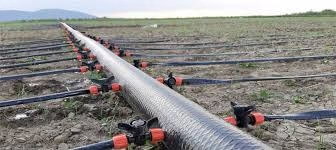
The advantages of using folding threaded pipe
As mentioned earlier, one of the main advantages of black cotton pipe is its light weight, which simplifies installation and reduces shipping costs. Ease of installation not only reduces labor costs, but also enables faster completion of work.
The flexibility of the cotton tube makes this product ideal for rough environments. These pipes show very good resistance to wear and tear, which have a longer life compared to other pipes.
The cotton tubing is also kink-resistant and ensures a continuous, uninterrupted flow of fluids. Additionally, its collapsibility when not in use makes it easy to store and a practical choice for both temporary and permanent installations.
The affordability of black pipe adds to its appeal for various applications. Its durability means less need for replacement and repair over time, resulting in cost savings.
The availability of complete sizing of threaded pipe means this. that users can choose the pipes according to their needs. This increases productivity and reduces waste. Overall, a combination of light design, high durability and cost-effectiveness make threaded pipes the optimal choice. It is suitable for a wide range of fluid transfer needs, especially in the agricultural sector. In short, the following are the advantages of threaded pipe in agriculture:
Suitable for all types of uneven terrain
Ability to collect and carry easily
Economic price
High durability
Easy installation
Threaded pipe sizes
Threaded pipe which is usually used in various agricultural applications. Available in different sizes to meet different needs. Among the most common sizes used are 2-inch threaded pipe, 3-inch threaded pipe, and 4-inch threaded pipe. Each of these sizes has specific uses. And understanding their differences is very important to choose the right one for your project.
2 inch threaded pipe
2-inch threaded pipe is commonly used in systems where less flow of water or other fluids is required. This pipe is usually found in smaller piping systems. 2 inch threaded pipe is often chosen due to its high versatility. Because it can be easily connected to other connections and devices. and ensure efficient water transfer in smaller applications.
3 inch threaded pipe
3-inch threaded pipe, often for installations. Slightly larger ones that require more current capacity are used. 3 inch threaded pipe is commonly used in piping systems, drainage systems and irrigation facilities. This pipe creates a balance between the size and speed of the flow. making it an ideal choice for medium-scale applications. 3-inch threaded pipe with the ability to transfer more volume of fluid. While maintaining the required space, it offers more efficiency.
8 inch threaded pipe
8 inch threaded pipe is used in larger and more difficult applications. These tubes are often used in environments where high flow rates are necessary. The 8 inch threaded pipe size allows it to move a significant volume of water. The 8-inch threaded pipe, despite its larger diameter, is still designed for easy connection with other components. and makes it a reliable choice for robust installations.
2-inch threaded pipe, 3-inch threaded pipe, and 8-inch threaded pipe each have unique strengths. And choosing the right pipe depends on the specific requirements of the project. 2 inch threaded pipe is ideal for smaller systems. The 3-inch threaded pipe provides a balanced solution for medium applications. And the 8-inch threaded pipe provides the capacity needed for larger, high-flow systems. By understanding the differences and uses of these threaded pipe sizes, you can ensure optimal performance and efficiency of your system.
What is polyethylene pipe?
Black pipes that are widely used in agriculture to transport water. These pipes are flexible and you can change their direction in any direction you want without needing to kneel. Polyethylene pipe is made of polyethylene plastic material, which has a lifespan of more than 20 years.
Where to buy polyethylene pipe?
It has been seen that many manufacturers have produced non-standard pipes with standard seals without any license. These pipes, which are generally sold under different brands, have a hot market due to the ignorance of buyers and their desire to buy cheaper! Even some contractors say that profiteers produce and market their pipes in the name of reputable brands!
It is obvious that in this profit-seeking market, when buying agricultural pipes, you must be careful not to face problems in the future.
Some polyethylene pipes offered in the market, even when welding plastic, the buyer and the contractor face serious problems.
The pipes that are offered in this store are all from factories that have a standard seal and have the approval of agricultural jihad
A step-by-step guide to buying agricultural polyethylene pipes
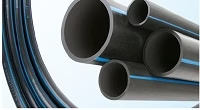
Calculate the atmospheric pressure of the polyethylene pipe
To buy a polyethylene agricultural pipe, the first step is to calculate the pressure on the pipe.
For example, if you have a 1000 meter route and you want to pump water through the pipe. The water pressure inside the pipe should be calculated according to the volume of incoming water, slopes and uphills and the length of the pipe. Usually, these matters are calculated by an engineer or contractor.
If you don’t know exactly what type of atmospheric pressure you should consider when buying an agricultural pipe. Be sure to get the atmospheric pressure of the pipe by contacting the free polyethylene pipe purchase consultation department.
The atmospheric pressure of the pipe will determine the weight and the weight will determine the price. So somehow manage this case in the future. Do not spend heavy expenses on your hands or spend more than you need right now.
After getting detailed information about the project implementation, the type of pipe will definitely be determined. We don’t mean size; Rather, it is the tolerance of atmospheric pressure by the pipe. Now, what does this sentence mean:
PE80 or PE100 polyethylene pipe purchase guide
Polyethylene pipes are produced in PE80 and PE100 standards.
But what is the difference between PE80 and PE100 pipes?
PE80 polyethylene pipe
These pipes are thicker than PE100, and as a result, they have the ability to withstand more pressure. This type of standard has more flexibility due to more weight.
These types of pipes are usually rolled even up to size 125!
PE100 polyethylene pipe
This type of standard also currently has a hot market. Pipes produced with this standard have less thickness and therefore lighter weight.
If you remember, we learned in the previous training material. The price criterion of polyethylene pipe is its weight, that is, the weight of one meter of pipe is the price criterion. ?
We want to get to the previous question here: What is atmospheric pressure?
According to their thickness, pipes can withstand pressure from inside or outside. We call it atmospheric pressure, which is represented by the letter A.
With this premise, if we want to buy agricultural pipes, we have a choice between two options: PE100 and PE80. We must say that if more pressure tolerance is important to you, you should definitely consider PE80 when buying agricultural pipes. And if there is not much pressure on the pipe, you can. Choose PE100 to reduce costs!
This issue was identified with the plan. For greater external or internal strength of the pipe, we must pay special attention to the standard type of pipe as well as its pressure tolerance (thickness).
What is the reason for the price difference of polyethylene agricultural pipe?
If you look around in the market, you will notice that there are different prices for two production pipes with the same specifications.
The reason for this price difference is related to short selling before it is related to high selling.
In fact, some factories use old materials to increase production profits and attract more customers. These pipes are used, which will definitely lead to a severe reduction in quality.
Of course, some factories or distributors also sell expensive. , that these factors must be considered by you.
On the new Absar website, the instant (online) price of polyethylene pipe is transparently available to the customer by selecting the pipe size.
Absar’s new store in order to protect the rights of consumers and comply with the principles of customer orientation. With transparency and the price of the day, it intends to provide a small share of the service.
If you want to buy polyethylene pipe, you can contact our experts for free
We will answer your questions regarding the purchase of agricultural pipes and polyethylene pipes