 Novin Absar
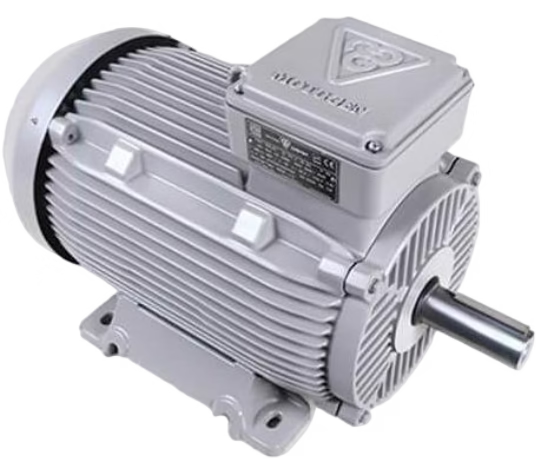
Cast Iron Three-Phase Electric Motor 1500 RPM
Specifications
| Motor Speed | 1500 rpm |
|---|
Cast Iron Three-Phase Electric Motor 1500 RPM
In 1882, Nikola Tesla laid the foundations of the rotating magnetic field and paved the way for using the rotating field as a mechanical force.
The movement that Nikola Tesla began in 1888 was what some today call the Second Industrial Revolution, as it led to easier production of electrical energy as well as the possibility of transmitting electrical energy over long distances. Before Tesla's invention of alternating current motors, motors were driven by the continuous movement of a conductor through a fixed magnetic field. Tesla pointed out that the motor's commutators could be eliminated so that the motor would be driven by a rotating field. Tesla later obtained U.S. Patent No. 0,416,194 for his motor invention. This motor, which appears in many photos of Tesla, was a special type of induction motor.
In 1890, Mikhail Osipovich invented a three-phase squirrel-cage rotor motor. This type of motor is widely used today for various applications.
Types of Electric Motors
In today's advanced machine-driven life, there is no person who has not encountered an electric motor or dynamo, although they may not notice it. In general, wherever there is movement, there is an electric motor.
- DC Motor
- Series motor
- Shunt motor
- Compound motor
- Self-excited motor
- Permanent magnet motor (PMDC)
- AC Motor
- Induction motor
- Synchronous motor
- Special motors
- Stepper motor
- Brushless DC motor
- Hysteresis motor
- Reluctance motor
- Universal motor
Electric Motor
An electric motor is a machine that converts electrical energy into mechanical motion. The general idea is that when a conductor carrying an electric current is subjected to a magnetic field, a force is exerted on that current-carrying conductor by the magnetic field. Most electric motors are rotary, but linear motors also exist.
Every rotary electric motor consists of two parts: a moving part and a driving part. The moving part is called the rotor, and the stationary part, usually inside the motor, is called the stator. In an electric motor, the rotor rotates about its axis due to the torque generated by the force created by the magnetic field in the stator. Each electric motor is powered by direct current (DC) or alternating current (AC) according to its structure.
How to Choose an Electric Motor
The first point to consider when choosing an electric motor is whether the voltage at the installation site is single-phase or three-phase. Electric motors are selected based on power, speed, and mounting method.
If the motor power is not specified, it can be determined by considering the required output torque. Motor power is expressed in kilowatts and its torque in newton-meters. The motor speed is selected according to the final speed of the driven machine and is usually 900, 1400, or 2900 RPM. Electric motors can be mounted on a base.
If the electric motor is coupled directly to a gearbox or hydraulic motor, it must have a flange at the output. The flange can be produced as small (B14) or large (B5) according to customer requirements. It should be noted that the motor housing is made of cast iron or aluminum, selected according to working conditions, required weight, and the device's vibration level.
Related products