 Novin Absar
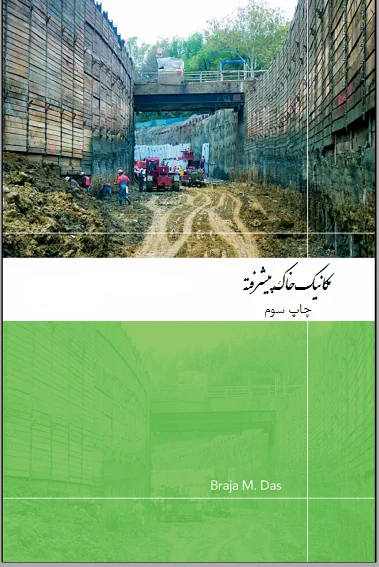
Advanced Soil Mechanics
$0.26
Advanced Soil Mechanics
Advanced Soil Mechanics deals with soils, which are a collection of mineral particles together with air and/or water in the voids, forming three-phase systems. A large part of the Earth's surface is covered by soil, and it is widely used as a construction material.
The fundamentals of soil mechanics are a branch of engineering that addresses the engineering properties of soil and its behavior under stress.
This book is divided into eight chapters: "Soil Mass, Plasticity, and Classification," "Stresses and Strains – Elastic Equilibrium," "Stresses and Displacements in the Soil Mass," "Pore Water Pressure Due to Undrained Loading," "Permeability and Seepage," "Consolidation," "Shear Strength of Soils," and "Settlement of Foundations." This chapter provides a brief overview of some soil properties and their classification. The reader is expected to be familiar with the basic principles of soil mechanics.
A natural soil sample may contain particles of different sizes.
Over the years, various agencies have attempted to establish size limits
for gravel, sand, silt, and clay. Table 1.1 shows some specific particle sizes.
Referring to Table 1.1, it is worth noting that some agencies classify clay as particles smaller than 0.005 mm in size, while others classify them as particles smaller than 0.002 mm.
Clay minerals—clay particles—necessarily tend to develop
plasticity when mixed with water; these are clay minerals. Kaolinite,
illite, montmorillonite, vermiculite, and chlorite are examples of clay minerals.
After payment the download button is enabled here and in your orders.